Panel coverage & variability
The 222-SNP pigmentation panel read at its hg19 positions, across the modern reference and the archaics
The question
Before any pigmentation result can be trusted, the panel has to be covered: at each panel SNP, how deep is the sequencing, where are the gaps, and what genotypes do the samples carry? This page is the coverage/depth QC for the panel.
Reading the panel at the right coordinates
The panel is defined by rsIDs, but the SGDP and archaic data are physically on hg19/hs37d5. Each panel SNP therefore has to be read at its hg19 position — a panel SNP’s hg38 position lands on the wrong base in hg19 data (for the tracer SLC24A5 that is 15:48426484 on hg19, not the hg38 15:48134288). The matrices below read all 222 panel SNPs at their verified hg19 coordinates, across 159 SGDP moderns + the 6 high-coverage archaics (161 of the 222 loci are variable and shown). Substrate + code: output/panel_matrix/, code/export_panel_matrix.sh, plan/figures/make_panel_heatmaps.R.
SEPIA analyzes 9 archaic genomes in total — the 6 high-coverage shown here, plus 3 low-coverage (Les Cottés, Denisova 11, Goyet, ~2×) carried in a separate depth table. This is a deliberate subset of the archaics in the earlier work: genomes that are exome-capture only, redundant with a higher-coverage library of the same individual, or too shallow to genotype the panel reliably are excluded by documented inclusion criteria, because at ≤2× coverage they add samples but essentially no trustworthy panel genotypes.
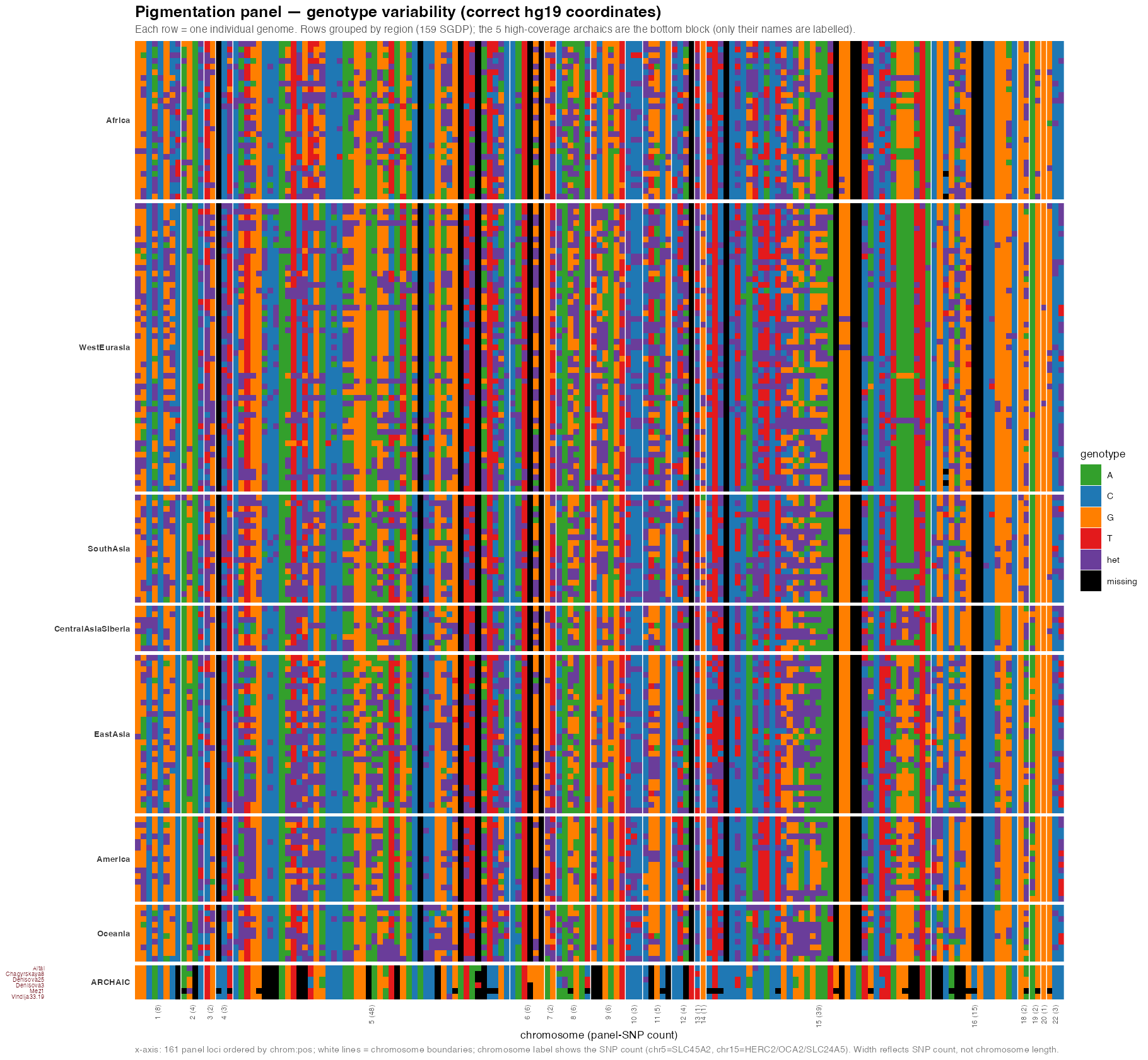
Genotype variability
Each cell is a sample’s genotype at a panel SNP: homozygotes coloured by base (A/C/G/T), heterozygotes purple, and missing calls black. Solid columns are monomorphic loci; mixed columns are the variable, informative ones. Rows are individual genomes grouped by region, with the archaics as the bottom block — where the missing calls concentrate.
Read depth, by chromosome
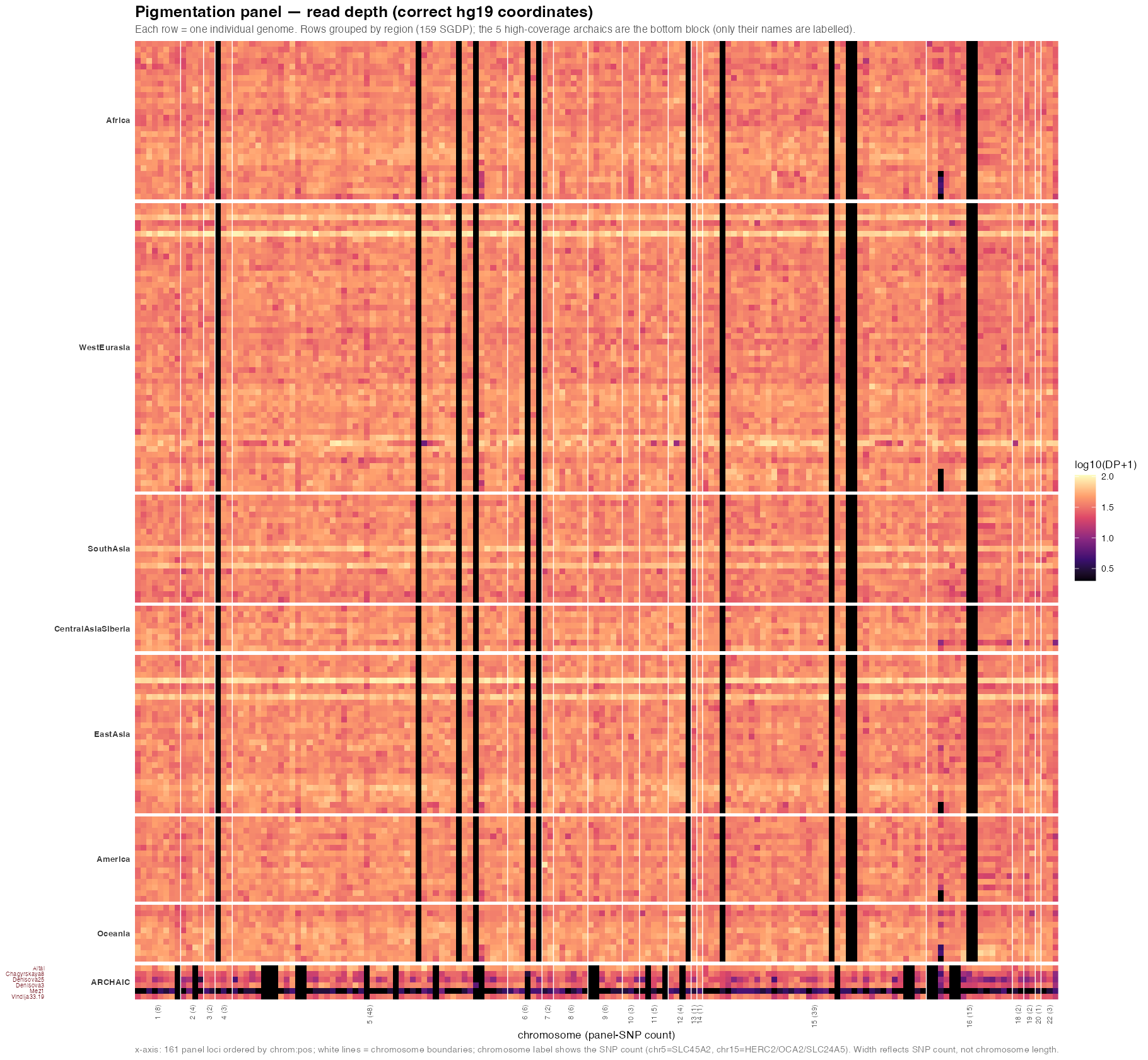
Per-sample read depth at each panel SNP, log-scaled. The 159 moderns are uniformly high-coverage (light); the 6 high-coverage archaics form the darker, more variable band at the bottom, with genuine missing positions in black. Chromosome labels carry the panel-SNP count — chr5 (SLC45A2) and chr15 (HERC2/OCA2/SLC24A5) hold more than half the panel, so their spans are wide by SNP count, not chromosome length.
Reading it
- The modern reference is essentially fully covered at the panel; the coverage question is really about the archaics, where depth is lower and patchier — which is why a per-call genotype-confidence layer (depth-aware) is needed before the archaic calls are used downstream.
- The heatmaps show all 6 high-coverage archaics, including Chagyrskaya 8 (its
.noRBVCFs were stored as plain gzip rather than BGZF, so they couldn’t be random-accessed until recompressed — a fixed extraction bug, not missing data). - The 3 low-coverage archaics (Les Cottés, Denisova 11, Goyet) are BAM-only and ~2×; their panel depth is recovered separately (streamed from the read archives) rather than shown in these VCF-derived heatmaps.
- A genome-wide depth background — to compare panel depth against the rest of the genome — is the natural next layer.