Code
library(ggplot2)
have <- all(file.exists(file.path("output/projections",
c("wg_after_modern.tsv","wg_after_archaic.tsv","pig_after_modern.tsv","pig_after_archaic.tsv"))))Build the PCA on modern humans, project the archaics onto it: do they sit differently in pigmentation than genome-wide?
Pigmentation is under selection and its genetics need not track genome-wide ancestry. So: if we place the archaic hominins (Neanderthals, Denisovans) relative to modern human structure, do they fall in the same place when we use the whole genome as when we use only pigmentation loci?
For both the whole genome and the pigmentation panel we do the same two steps:
Concretely, with plink2:
# 1. modern basis (per-allele loadings + reference allele counts)
plink2 --bfile MODERNS --freq counts --pca 10 allele-wts --out modpca
# 2. project the archaics onto it
plink2 --bfile ARCHAICS --read-freq modpca.acount \
  --score modpca.eigenvec.allele <id-col> <a1-col> header-read \
  no-mean-imputation variance-standardize --score-col-nums <PCs> --out arc_proj
variance-standardize standardizes each SNP by the modern allele frequency (so the archaic sits on the modern axes’ scale), no-mean-imputation drops a missing archaic genotype rather than filling it with the reference mean (so gaps don’t drag a sample toward a false centre).ALT='.' at most sites) never match the moderns by ID. Full runnable recipe: code/project_archaics.slurm.Validation. Before trusting the archaic scores, we score the moderns with their own weights and confirm it reproduces their PCA — here |r| = 1.00, so the projection is faithful. (The sign comes out flipped between --pca and --score, so we take the moderns from their own self-projection too, to keep both on one convention.)
library(ggplot2)
have <- all(file.exists(file.path("output/projections",
c("wg_after_modern.tsv","wg_after_archaic.tsv","pig_after_modern.tsv","pig_after_archaic.tsv"))))rd <- function(f) read.delim(file.path("output/projections", f), stringsAsFactors = FALSE)
hicov <- c("Chagyrskaya8","Denisova3","Denisova25","Denisova5","Vi33.19")
summ <- function(space) {
m <- rd(paste0(space, "_after_modern.tsv")); a <- rd(paste0(space, "_after_archaic.tsv"))
a <- a[is.finite(a$PC1), ]
data.frame(space = space,
modern_PC1_range = sprintf("%.2f to %.2f", min(m$PC1), max(m$PC1)),
hicov_archaic_PC1 = sprintf("%.2f (mean)", mean(a$PC1[a$IID %in% hicov])),
n_modern = nrow(m), n_archaic = nrow(a))
}
knitr::kable(rbind(summ("wg"), summ("pig")),
caption = "Modern PC1 span vs where the high-coverage archaics project.")| space | modern_PC1_range | hicov_archaic_PC1 | n_modern | n_archaic |
|---|---|---|---|---|
| wg | -0.32 to 0.07 | -0.23 (mean) | 159 | 14 |
| pig | -0.32 to 0.22 | 0.14 (mean) | 159 | 5 |
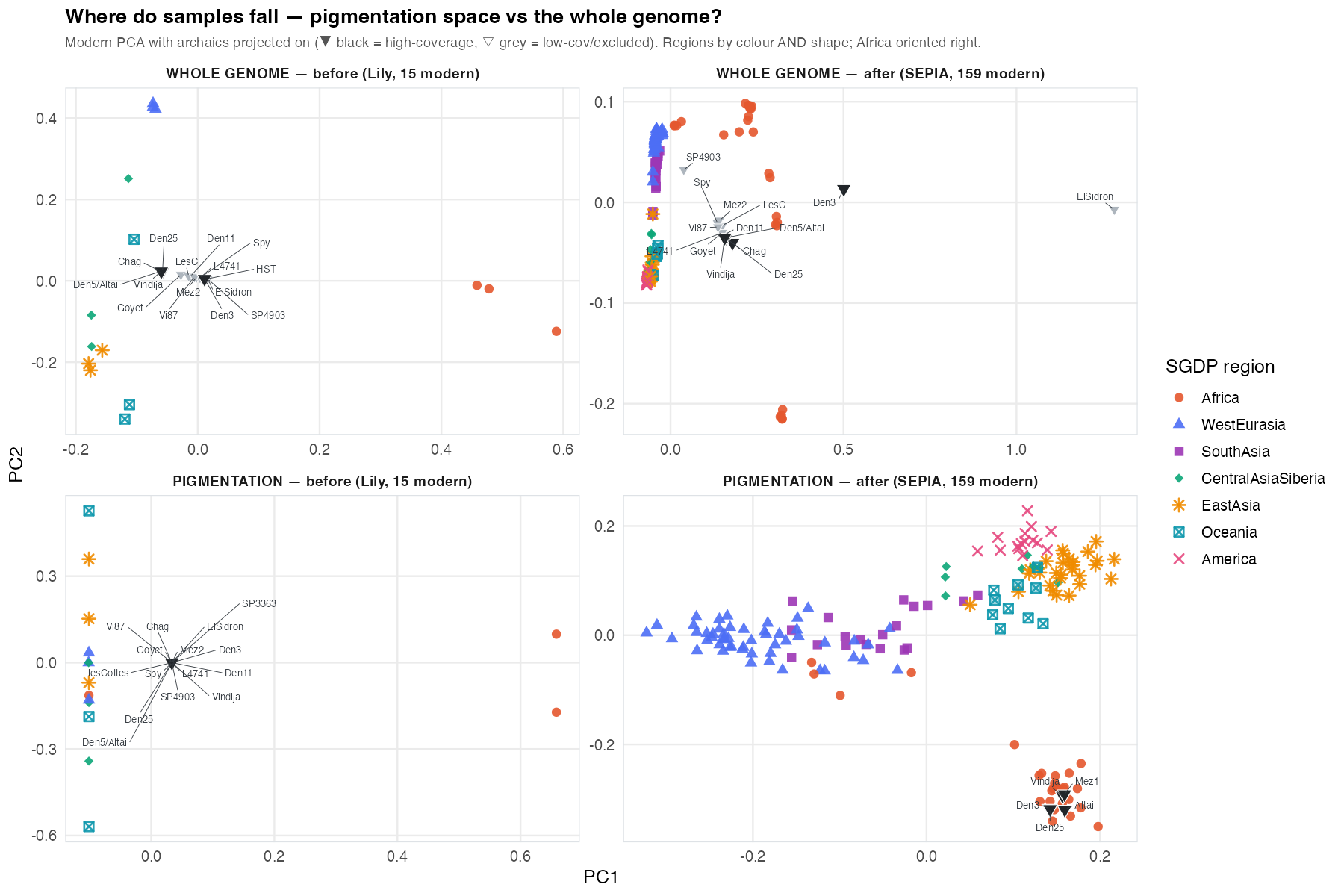
The contrast is the result: pigmentation does not recapitulate genome-wide ancestry. But the “archaics cluster with Africans in pigmentation” panel must be read carefully:
The analysis above leans on a specific ascertained SNP panel. To test whether “archaics with Africans” is real or a panel artifact, we ran the same recipe on all variation across the 1,004 pigmentation-gene regions (gene body ±10 kb; ~17,500 LD-pruned, unascertained variants — the gene network, not hand-picked SNPs; code/gene_region_pca.slurm, built from data/pigment_gene_map.tsv).
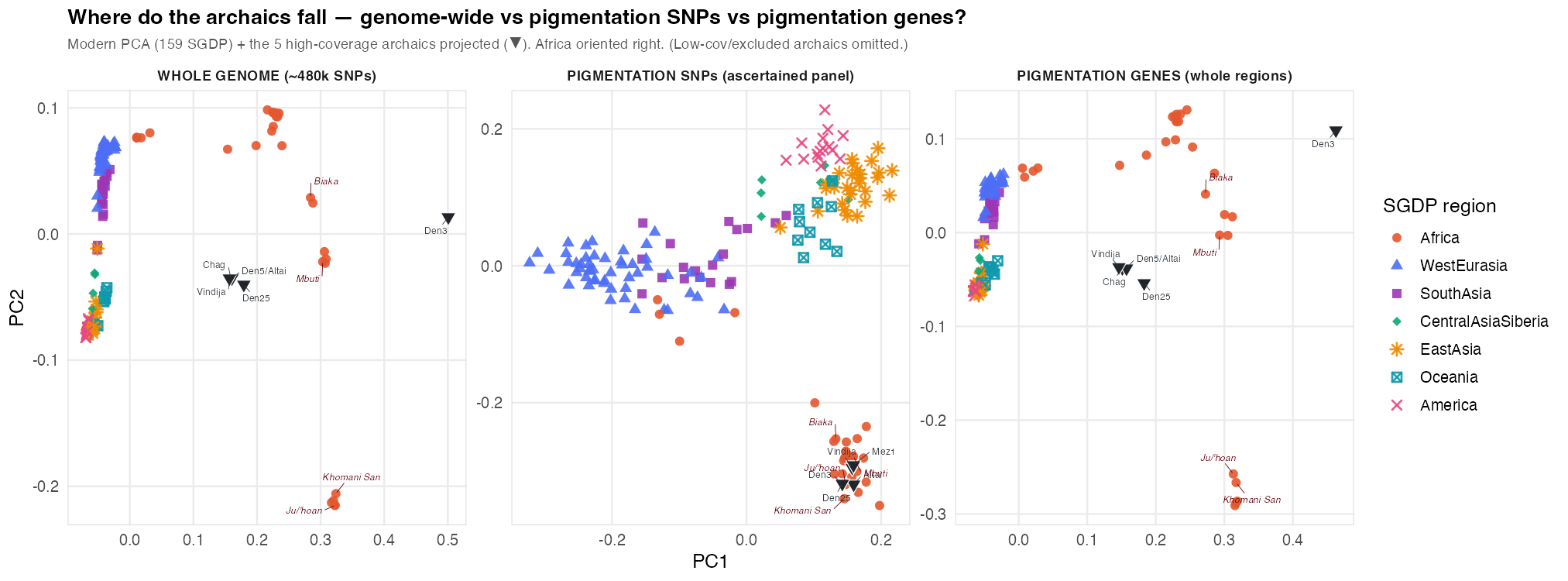
Result. The whole-genome and pigmentation-gene-region panels are near-identical — archaics project as a divergent outgroup at the non-African edge (high-coverage PC1 ≈ 0.15, matching to two decimals). Only the pigmentation-SNP panel places archaics with Africans.
Interpretation — genes = ancestry, ascertained SNPs = selection. Pigmentation genes carry ordinary genome-wide ancestry: any decent unascertained genomic sample recovers the same population structure, so the gene-region PCA ≈ the whole genome. What makes the SNP panel different is that it is enriched for the selected, derived (out-of-Africa light-skin) alleles — there archaics (ancestral) line up with the Africans who also retain the ancestral state. So the pigmentation-SNP “archaics with Africans” is the footprint of selection at hand-picked loci, not a pigmentation-gene ancestry signal. Real and phenotype-relevant, but read as shared ancestral alleles at light-skin loci, not as ancestry.
The African samples fan out in two tiers (the expected human-diversity hierarchy): the KhoeSan — Ju/’hoan (×3) and Khomani San (×2) — are the earliest-splitting human lineage, so they occupy their own axis (they sit alone in a cleanly separated cluster, well off on PC2). The Central African rainforest hunter-gatherers Mbuti and Biaka are divergent along PC1 (the African end of the African–non-African axis) but cluster with the other Africans on PC2 — not down with the KhoeSan. North Africans (Mozabite, Saharawi) sit nearest the non-Africans (Eurasian admixture). In the pigmentation-SNP panel these deep-African groups pull toward the archaics because they retain the most ancestral pigmentation alleles. (One sample, LP6005441-DNA_A09, shows as “unknown” — its library ID is missing from data/sgdp_metadata.tsv; a metadata gap to fill, not a data problem.)